Child Passport Guide: Applying for a Passport for a Minor Under 16
Passport applications for children under 16 have stricter requirements than adult applications — both parents must typically be present or provide consent. Here is every scenario explained.
Last updated: 2026 · 10 min read
Why Children Under 16 Have Different Rules
The U.S. State Department requires parental consent for passport applications for minors under 16 to help prevent international parental child abduction. Both parents or guardians must demonstrate awareness of and consent to the child traveling internationally. This requirement applies even if parents are married and living together — both must appear or one must provide the DS-3053 form.
Children aged 16–17 use the same DS-11 form but have slightly relaxed requirements — they may apply without a parent present in some circumstances, though a parent's signature is still required on the form.
Scenario 1: Both Parents Can Attend (Simplest)
If both parents or legal guardians can appear at the acceptance facility together with the child, this is the most straightforward path:
- Completed DS-11 form (signed by one parent/guardian at the facility — do not pre-sign)
- Child's certified birth certificate (showing both parents' names)
- Photocopy of child's birth certificate
- Passport photo for the child (2×2 inch)
- Photo ID for one or both parents (depends on facility)
- Photocopy of presenting parent's ID (front and back)
- Application fee: $100 (book) or $15 (card) for under 16
- Acceptance fee: $35 (paid to facility)
Both parents sign the DS-11 in front of the acceptance agent, or one parent signs and provides ID for both.
Scenario 2: One Parent Cannot Attend — DS-3053 Required
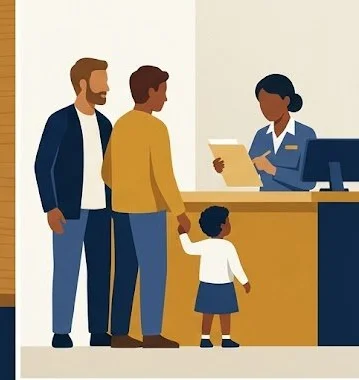
If one parent cannot be present, the attending parent must bring a completed, notarized Form DS-3053 (Statement of Consent) signed by the absent parent. This is the most common scenario and the one that causes the most confusion.
How DS-3053 Works
The absent parent must:
- Download and complete DS-3053 from travel.state.gov
- Sign it in front of a notary public (NOT at the passport facility)
- Provide it to the attending parent to bring to the appointment
The DS-3053 must be an original notarized document — a photocopy or digital version is not accepted. The absent parent's signature on DS-3053 must be witnessed by a notary, not just self-certified. The notarization must be a standard U.S. notarization with the notary's seal and signature.
Along with DS-3053, bring: the completed DS-11, child's birth certificate, your photo ID, photocopy of your ID, and the child's passport photo. The absent parent does not need to provide their photo ID unless there is a naming discrepancy on the birth certificate.
Scenario 3: One Parent Has Sole Legal Custody
If you have sole legal custody of the child and the other parent's consent is legally not required, you can apply without DS-3053 — but you must bring evidence of sole custody:
- A court order granting sole custody to you, and
- Evidence that the other parent's rights have been terminated, OR the custody order explicitly permits you to obtain a passport without the other parent's consent
Bring the original court document and a photocopy. If the court order is ambiguous about international travel or passport applications, the acceptance agent may still request DS-3053. Courts that grant sole custody don't always specify passport rights — check your specific order.
Scenario 4: Other Parent Is Deceased
If the other parent is deceased, bring the original death certificate (or a certified copy) along with your DS-11 and other standard documents. No DS-3053 is needed. A photocopy of the death certificate is also required.
Scenario 5: Other Parent's Whereabouts Are Unknown
If you genuinely cannot locate the other parent, you can complete a Form DS-5525 (Statement of Exigent/Special Family Circumstances) explaining the situation. You will need to demonstrate that you have made reasonable efforts to locate the other parent. The State Department reviews these on a case-by-case basis and may require additional documentation. Contact the State Department directly (1-877-487-2778) before your appointment if you're in this situation.
What to Bring: Complete Child Passport Checklist
Keep Each Family Member's Documents Separate and Organized
When applying for a child's passport, you're often juggling documents for multiple people — the child's birth certificate, both parents' IDs, the DS-3053, and photos. A family travel document organizer with individual passport slots makes it easy to keep everything sorted and hand the agent exactly what they need without digging through a folder.
Family Travel Document Organizer on Amazon →
As an Amazon Associate, we earn from qualifying purchases. Learn more.
- Completed DS-11 — do not sign beforehand One form for the child. Both parents' information is included on the form even if only one attends.
- Child's certified birth certificate Must show child's full name, date of birth, place of birth, and both parents' full names. Hospital birth certificates are not accepted.
- Photocopy of birth certificate
- Child's passport photo — 2×2 inch, taken within last 6 months For infants and young children: eyes must be open. It's okay if a parent's hand is visible holding the baby, as long as the background is white. Some USPS locations have adjustable setups for infant photos.
- Proof of parental relationship (if not on birth certificate) If you are a legal guardian rather than a biological parent, bring the court order establishing guardianship.
- Photo ID for the attending parent/guardian
- Photocopy of attending parent's ID (front and back on same page)
- DS-3053 (if one parent absent) — original notarized copy Or custody documentation if applicable. See scenarios above.
- Application fee: $100 (book) payable to U.S. Department of State by check or money order
- Acceptance fee: $35 payable to the facility
Child Passports: Ages 16 and 17
Applicants aged 16–17 apply with DS-11 but do not require both parents to be physically present. The applicant may appear alone — but the DS-11 must be signed by a parent or guardian (not just the applicant). If the teen appears without a parent, bring a parent-signed DS-11 and the parent's photo ID (plus a copy).
Passports issued to applicants aged 16–17 are valid for 10 years, the same as adult passports. Passports issued to children under 16 are valid for only 5 years.
Fees for Child Passport Applications
| Item | Under 16 | Ages 16–17 |
|---|---|---|
| Passport Book | $100 | $130 |
| Passport Card | $15 | $30 |
| Acceptance Fee | $35 | $35 |
| Expedited Processing | +$60 | +$60 |
| Validity Period | 5 years | 10 years |
Tips for Passport Photos of Infants and Young Children
Getting a compliant passport photo of a baby or toddler is one of the trickier parts of the process. A few practical approaches:
- For infants: Lay the baby on a plain white sheet or blanket, take the photo from directly above. The State Department specifically permits this approach. You can hold the baby as long as your hands aren't near the face.
- For toddlers: Many professional photo locations (USPS, CVS, Walgreens) have experience with young children. Call ahead to ask — some post office passport specialists are particularly good with kids.
- Eyes must be open — this is the most common rejection reason for infant photos. Natural light and a feeding break before the photo session helps.
- Do not use a carseat as the background — the fabric pattern disqualifies the photo. The background must be plain white.
How Long Do Child Passports Take?
The same processing times apply to child passports as adult passports: 6–8 weeks routine, 2–3 weeks expedited. Because child passports are only valid for 5 years, many families choose to get them at the last minute before a specific trip rather than well in advance. This is fine, but leave yourself time — if you're traveling within 14 weeks, pay for expedited service. If traveling within 6 weeks, see the expedited passport guide.
Find a Facility That Handles Child Passports
Most USPS and county clerk acceptance facilities handle child passport applications. Use our county finder to check walk-in policies and photo service availability in your area.
Frequently Asked Questions
Technically yes — the State Department requires both parents or guardians to appear or provide consent via DS-3053. However, in practice, if one parent cannot attend, the DS-3053 is the standard solution regardless of marital status. Many acceptance agents will process an application if only one parent appears and the birth certificate clearly shows both parents, especially if the parents share a last name — but this is at the agent's discretion and not guaranteed. The safest approach is to either both attend or bring a notarized DS-3053 from the absent parent.
Only if they are legal guardians. A grandparent who is the child's legal guardian can apply with proof of guardianship (court order). A grandparent who is not the legal guardian cannot apply — even with a note from the parents. The parents (or legal guardians) must either appear or provide DS-3053 consent.
If only one parent is listed on the birth certificate, only that parent's presence or consent is typically required. However, this can be complicated if the father's parental rights have been legally established separately. If you're in this situation, call the State Department (1-877-487-2778) before your appointment to confirm what documentation is needed.
Yes. The child must appear in person at the acceptance facility appointment. There is no exception to this requirement — the acceptance agent must see the child. For infants who cannot sit up, you will hold them during the appointment. Plan for extra time since infants and young children can make appointments take longer.